Hindustan Zinc and GreenLine Partner to Decarbonize Logistics with EVs and LNG Trucks
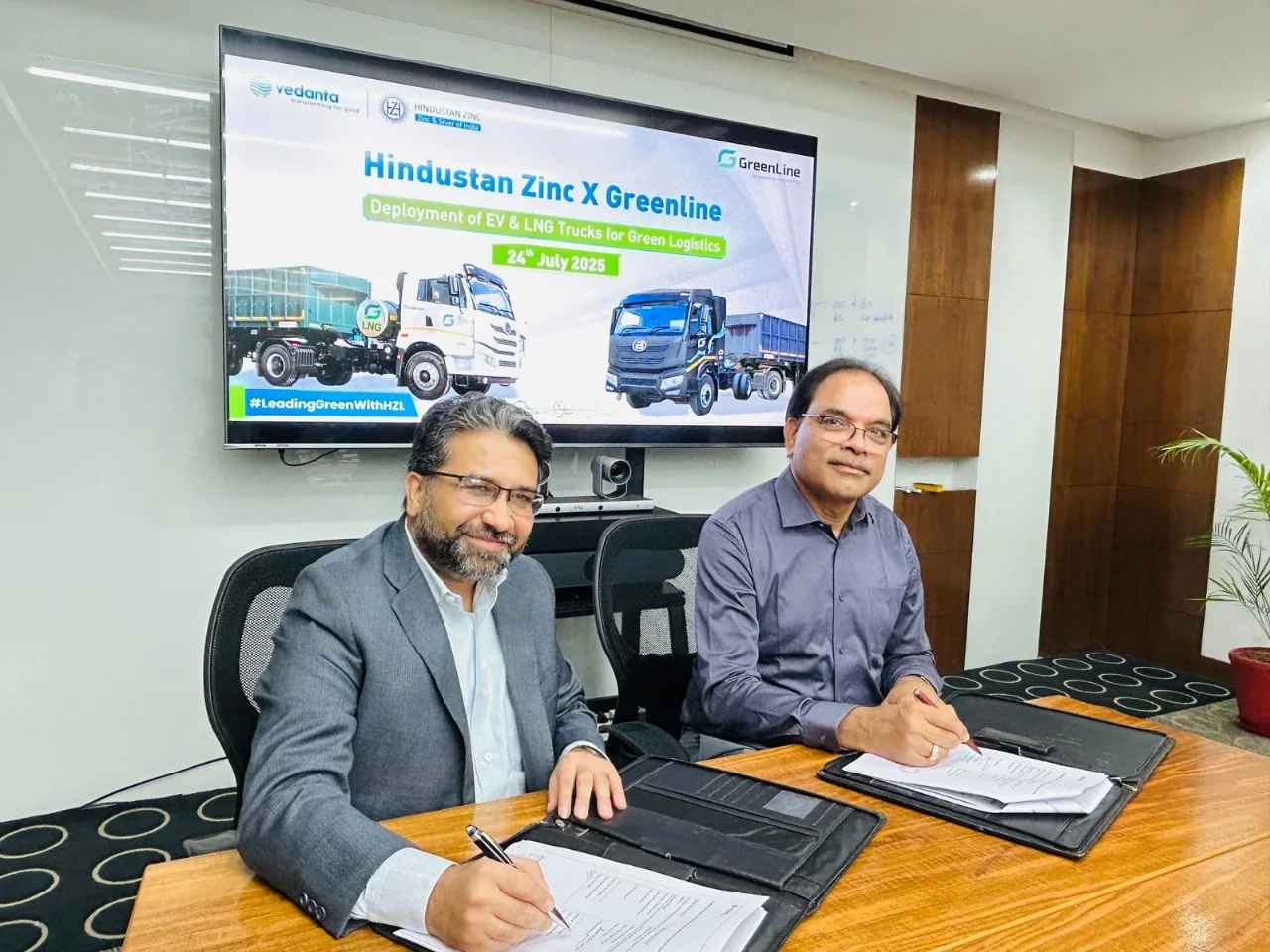
Hindustan Zinc Ltd (HZL), a Vedanta Group company, has expanded its partnership with GreenLine Mobility Solutions to decarbonize its logistics operations. The initiative involves deploying 100 electric vehicles (EVs) for short-haul transport and increasing the number of liquefied natural gas (LNG) trucks from 100 to 200 for long-distance movement. GreenLine will invest ₹400 crore (~USD 45.7 million) in this phase of the collaboration.
A major highlight is the development of India’s first commercial-scale battery-swapping infrastructure, with three high-capacity stations to ensure 24×7 EV operations. GreenLine’s LNG fleet, supplied by Blue Energy Motors, offers substantial emission reductions compared to diesel: 30% lower CO₂, 100% less SOₓ, 59% less NOₓ, 91% fewer particulates, and 70% less CO.
This move supports HZL’s Science-Based Targets initiative (SBTi)-approved goals to cut Scope 1 and 2 emissions by 50% and Scope 3 by 25% by FY2030, aiming for net-zero emissions by 2050 or earlier.
The partnership aligns with GreenLine’s broader plan to operate over 10,000 green trucks and establish a network of 100 LNG stations and EV battery-swapping/charging hubs across India, targeting a reduction of up to 1 million tonnes of CO₂ emissions annually.
A major highlight is the development of India’s first commercial-scale battery-swapping infrastructure, with three high-capacity stations to ensure 24×7 EV operations. GreenLine’s LNG fleet, supplied by Blue Energy Motors, offers substantial emission reductions compared to diesel: 30% lower CO₂, 100% less SOₓ, 59% less NOₓ, 91% fewer particulates, and 70% less CO.
This move supports HZL’s Science-Based Targets initiative (SBTi)-approved goals to cut Scope 1 and 2 emissions by 50% and Scope 3 by 25% by FY2030, aiming for net-zero emissions by 2050 or earlier.
The partnership aligns with GreenLine’s broader plan to operate over 10,000 green trucks and establish a network of 100 LNG stations and EV battery-swapping/charging hubs across India, targeting a reduction of up to 1 million tonnes of CO₂ emissions annually.